

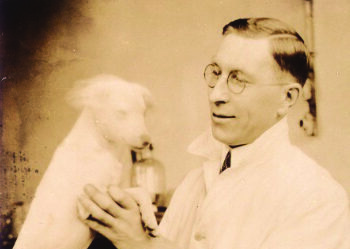
Discovered in 1921, insulin revolutionised diabetes treatment and offered a lifeline for people living with type 1 diabetes.
Before the miraculous discovery of insulin, life was very different for people diagnosed with type 1 diabetes.
Not only did living with the disease hinder their ability to perform usual day-to-day activities due to low energy levels, but the average life expectancy was between four to six years from the time of diagnosis. With no treatment available, diabetes was considered a terminal disease.
Living with type 1 diabetes was a grim prognosis – the person would often lose drastic amounts of weight in a short amount of time and, following a rapid depletion in their energy levels, they would eventually fall into a coma and die.
“Before insulin the main treatment was a starvation diet,” explains Canadian scientist Dr Bernard Zinman, a world-renowned research endocrinologist and Professor of Medicine at the University of Toronto’s Banting and Best Diabetes Centre.
“The patient slowly wasted away and with any minor illness went into diabetic ketoacidosis (DKA) and died.”
Although the idea to treat diabetes was originally conceived by Dr Frederick Banting in 1920, it wasn’t until 1921 that Dr Banting and his assistant Charles Best began working on an insulin dose that could be successful in treating diabetes in humans.
Then in late 1921, Dr Banting and Best – with the help of James Collip and John Macleod – teamed up to develop a successful ‘insulin treatment’ for people with type 1 diabetes.
In 1922, they managed to develop the first successful insulin treatment on 14-year-old boy named Leonard Thompson, who lay unconscious in a hospital bed having slowly deteriorated since his diagnosis.
It was promising news and a huge victory that not only validated the work of Dr Banting and his colleagues but also offered a beacon of hope for others who were living with the disease.
And while insulin wasn’t commercially available worldwide until 1923, Dr Zinman says early treatment was often a difficult and painstaking process.
“The early insulins were difficult to administer with frequent injection site reactions,” explains Dr Zinman, who has been involved in type 1 and type 2 diabetes research for more than 25 years.
“Glucose control was measured by urine testing and insulin dose adjustment was difficult.”
“Their pharmacokinetics were not ideal or consistent. Optimal management was difficult, and it soon became evident that the devastating long-term eye, kidney and never complications were a major problem.”
These early challenges spurred further work to improve insulin treatments and overall management of the disease.
“It soon became apparent that to better duplicate the insulin production from the failing pancreas both basal and meal insulin would be required,” Dr Zinman says.
“DNA recombinant technology allowed for the production of human insulin as well as the development of insulin analogues [designer insulins] most suitable for basal and meal replacement.”
It wasn’t until close to 50 years later in the 1970s that the first insulin pump became commercially available and would revolutionise diabetes management.
Professor Tim Jones, head of diabetes and obesity research at the Kids Institute and medical co-director at Perth Children’s Hospital, has been involved in diabetes research for more than 30 years and has seen diabetes technology evolve from brick-like contraptions to discreet, wearable devices.
“The first insulin pumps in the 70s were like a brick, you adjusted them with a screwdriver,” he explains.
“And now of course you’ve got the patch pumps which you just stick on and have a sensor to communicate and adjust how much insulin it gives, whether you’re going low or high.”
Professor Jones says blood glucose monitoring has also come a long way from the early urine test methods.
“Blood glucose monitoring is another advance in technology,” he says.
“We were testing urine up until the late 70s, then in the 80s we had fingerprick blood tests, then of course they improved dramatically in the accuracy and ease of use, and now we’ve got continuous glucose monitoring. We’re trying to get better outcomes in blood glucose levels but we’re also trying to reduce the burden of having diabetes because of the stress and mental health problems we see, and we still see a lot of them. It’s difficult to manage.”
Dr Zinman agrees that the invention of insulin pumps has been one of the biggest game-changers since the development of insulin itself.
“The development of insulin pumps advanced the goal of improving insulin administration and the opportunity to improve control and reduce the risk of hypoglycaemia,” Dr Zinman says.
“Intensive insulin treatment became standard of care. Newer basal and meal insulins in addition to better pumps were very important advances. The development of CGM (continuous glucose monitoring) provide the opportunity to adjust therapy with greater precision.”
As for his hopes for the future, Dr Zinman believes more research into the root causes of type 1 diabetes is needed in order to develop ways to prevent and even cure the disease.
“Understanding the precise cause of type 1 diabetes will be essential in establishing prevention strategies,” Dr Zinman says.
“In the interim, an affordable convenient closed loop system will hopefully soon be widely available and will transform the lives of patients with type 1 diabetes.”
While Professor Jones has largely been involved in type 1 diabetes research, he says the rise in the rates of type 2 diabetes in children is concerning and highlights the need to do more research in the type 2 prevention and management space.
“When I started, we didn’t see type 2 diabetes in kids,” he says.
“It’s only since about the late 90s that we’ve noticed it, and it’s about 10 to 15 per cent of our new patients now with type 2 diabetes.
“It’s a terrible disease in young people, it’s more aggressive, there are more complications and it’s hard to manage.”
Professor Jones says while he has seen more type 2 diabetes patients at the clinic, the stigma that is attached to the disease often provokes feelings of guilt and shame.
“There’s a huge stigma attached to (type 2 diabetes) because people think ‘Well it’s your fault you’ve got it,’ which is not fair, but that’s a bit of a problem,” he says.
Research has shown that women with gestational diabetes are up to seven times more at risk of developing type 2 diabetes within 10 years of giving birth, with their child also at a higher risk of developing obesity and type 2 diabetes.
Observational evidence has also found that a healthy lifestyle can help reduce the risk of developing type 2 diabetes in women who have a history of gestational diabetes, and that structured education programs – such as the online post-GDM program, Baby Steps – can be an effective way of encouraging better self-management in conditions such as diabetes.
In 2019, Diabetes WA was selected by the Australian Government to adapt and pilot Baby Steps for Australian users with the aim of providing a recommendation for a national rollout plan.
Professor Jones agrees that early intervention through lifestyle and diet changes during pregnancy can play a big role in breaking intergenerational diabetes by reducing the risks of type 2 diabetes in both women and their children.
“(The key is) to prevent the insulin resistance and improve lifestyle and diet early in life before they’re born, so during pregnancy,” he says.
As for what he would like to see achieved in the next 100 years in diabetes research, Professor Jones says developing islet transplantation without immune therapy would be a massive step towards finding a cure.
“I think that islet transplantation without immunotherapy would be the holy grail,” he says. “There are a lot of research groups looking at islet transplants that are trying to grow islets from stem cells and then change them so that the immune system does not reject them.
“That’s the problem with islet transplants at the moment, you have to do immunotherapy, which is not safe.
“I always look at insulin as an example – people have been working on what it was in the pancreas you could use to treat diabetes, what is missing, what is insulin, and people were working on that for decades prior to the discovery of insulin, and suddenly it happened one summer in Toronto – someone actually found it.
“So it’s a big build up and then it’s lots of little steps and all of a sudden, we get there.”
This article was first published in Diabetes Matters in autumn 2021.
Do you have any questions about diabetes and the latest technology?
We answer a lot of questions on the helpline about diabetes technology, and we are always happy to help you get started on new technology, including CGMs, or troubleshoot.
Call us for free on 1300 001 880.
An appointment with a diabetes educator can help you learn to use your CGM to support you and your lifestyle.
Get in touch if you’d like to make an appointment at our clinic, or make a Telehealth appointment if you’re living in rural or remote Western Australia.
CREDIT: Dr Frederick Banting image supplied by Thomas Fisher Rare Book Library, University of Toronto and Banting House National Historic Site of Canada.