

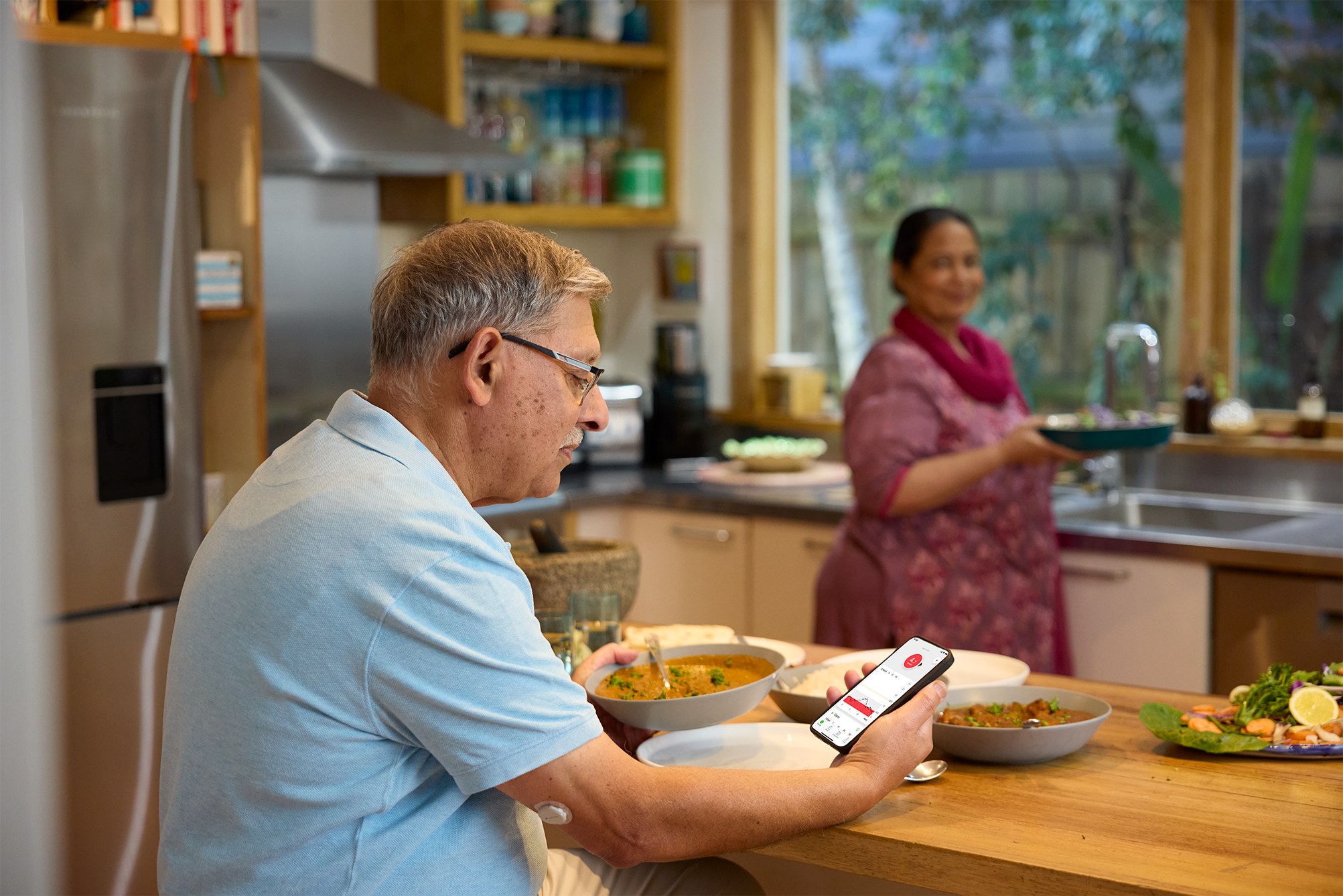
Have you noticed an increase in people wearing CGMs (continuous glucose monitors) on their upper arm? ZOE DELEUIL looks at what their growing popularity means for people living with diabetes.
Diabetes technology is a rapidly changing area of diabetes healthcare. In particular, CGMs, initially developed for people living with type 1 diabetes to track their blood glucose levels, are now increasingly adopted by people with all diabetes types, and even those without the condition.
Diabetes WA clinical services manager Jessica Weiss says that more people are using CGMs to self-manage their diabetes.
“CGMs can prevent high or low glucose levels with early warnings and alarms, reduce the need for finger-pricks – and the need to carry the equipment – and provide better information about what is influencing glucose levels.”
The case for more equitable funding
CGM technology is currently funded by the NDSS for people with type 1 diabetes. This provides access to a technology that has many benefits and can connect to other technology, such as insulin pumps and smart pens.
For people with type 2 and gestational diabetes, there is currently no subsidy for CGM technology. Those who can afford to self-fund pay $200 to $300 per month for a CGM.
Diabetes WA has now joined forces with diabetes organisations across the country to call on the Australian government to subsidise vital diabetes technology through national campaign Unite for Tech.
New CGMs entering the market
As demand for CGMs grows, an increasing number of non-NDSS-funded sensors have appeared on the market.
In response, the Australian Diabetes Society (ADS) and other diabetes organisations have published a joint statement calling for minimum standards regarding CGMs in Australia and New Zealand.
Jessica says that, while CGMs coming onto the market are approved by Therapeutic Goods Administration (TGA), consumers need to inform themselves when self-funding a CGM.
“There are questions around whether CGMs targeting the self-funded market have met the same rigorous testing to prove accuracy. It’s also important to understand what their support looks like (24-hour phone lines are standard with NDSS-approved CGMs), whether they can be trusted for making clinical decisions and where user data is stored.”
Equity of access in remote, regional and rural Australia.
Diabetes prevalence in Australia is 1.3 times higher in remote and very remote areas compared to major cities. Teletrials are currently investigating the cost effectiveness of CGMs in regional and remote areas, how best the technology can be used to improve health outcome, and how subsidies could support equity of access.
The FlashGM Teletrial investigates CGMs as an alternative to finger-pricking, which can be painful for some and lead to a loss of feeling in the fingers due to the buildup of scar tissue over many years of multiple daily finger-pricks.
This was the case with Ezzard Flowers, a Noongar Elder who participated in the trial. He hopes that in participating he will “help people better manage their diabetes and save them from going through what he has.”
Jessica Weiss sees the increased interest in CGMs as a positive development.
“Overall, CGMs reduce the burden of diabetes management, specifically in monitoring glucose levels. Modern diabetes technology has significant clinical and emotional benefits.”
Learn more about diabetes technology
Diabetes WA has joined Unite for Tech, a national movement calling for more equitable access to diabetes technology such as CGMs.
Have a question about CGMs and diabetes technology? Call our helpline on 1300 001 880 to speak to one of our diabetes educators.
Come along to one of our Tech Nights. Learn about the latest diabetes tech, meet other people living with diabetes, hear from our diabetes educators and speak to representatives from the companies.
Our next Type 1 Tech Night is on Tuesday 31 March 2026 from 6pm-8pm at George Burnett Leisure Centre, Manning Road, Karawara.
Book your ticket and sign up to the T1DE newsletter below to stay in touch.