

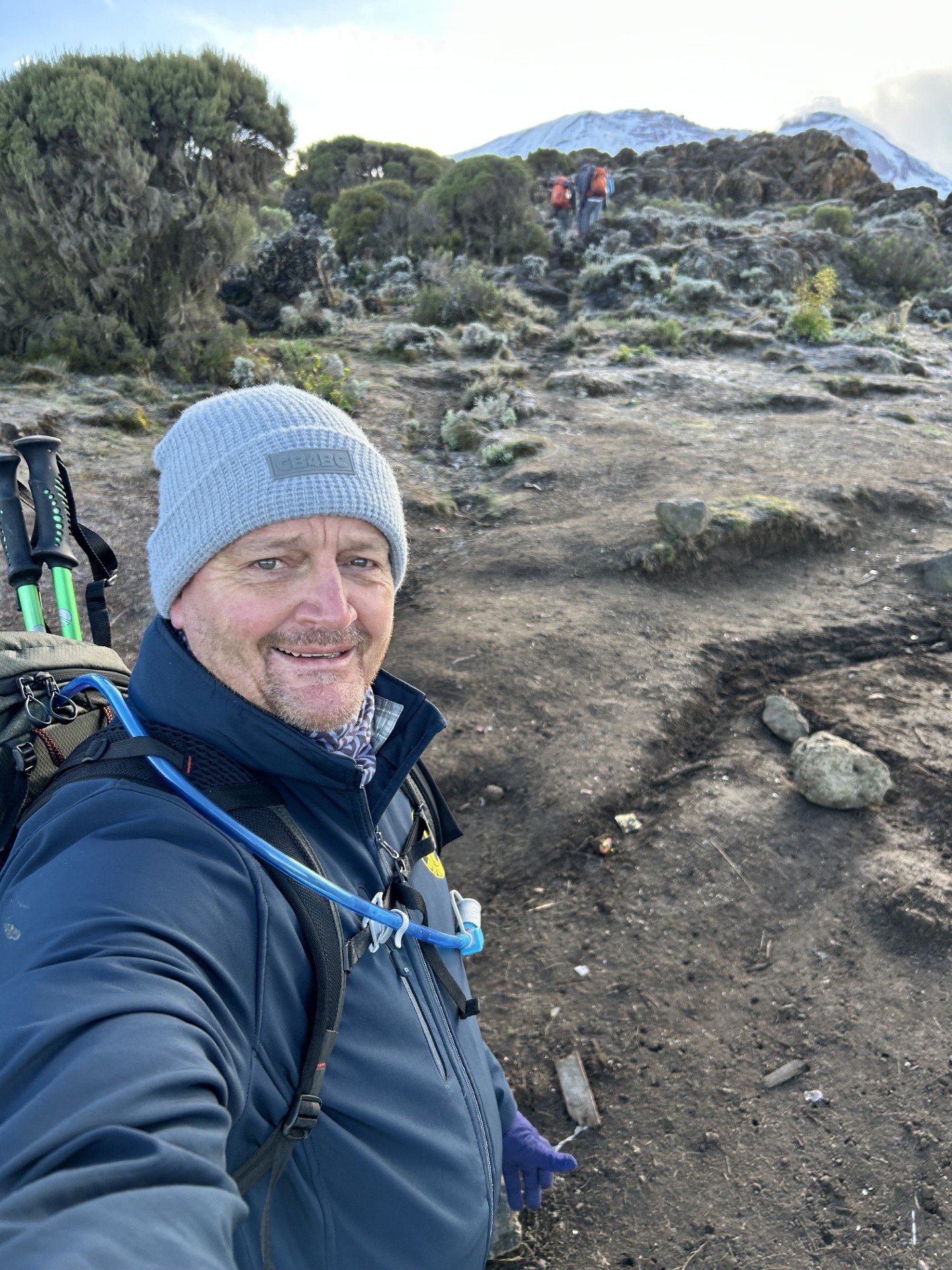
Geologist LEIGH SLOMP tells us about managing his type 1 diabetes and climbing Mount Kilimanjaro.
I’ve never been an extreme adventurer, although I’ve done the Avon Descent five times. A friend was climbing Mount Kilimanjaro and asked if I was interested and I said yes, knowing it would give me the internal motivation to improve my type 1 diabetes management.
My diabetes educator and I talked a lot about preparation and what situations I might encounter, which was invaluable. I also got in touch with Insulet, the manufacturer of my insulin pump, about how I’d handle the journey. And I started going to the gym, focussing more on fitness than weights.
We were a group of eight friends and acquaintances, all similar ages. My biggest worry was keeping the controller charged. I had to change pods in a tiny tent every day, trying not to freeze. I also packed injectable insulin in a cooler bag, just in case. I use a Dexcom CGM and needed to power both a phone and a pod controller, so I had a couple of battery packs, including a solar-powered one I hung off my pack.
I went through what I was carrying with everyone and told them, ‘Here are the things to do if I get a bit weird.’
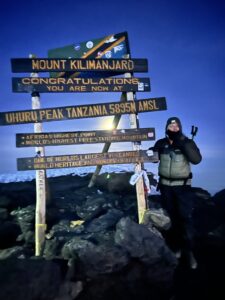
Most days we were trekking for four to six hours at a fairly slow pace, but to reach the summit for sunrise we took off at 11pm and trekked all night through snow and ice. That was the night that I gave myself too much insulin and started to become hypoglycaemic.
My lolly snakes weren’t doing anything and then, noticing I was flagging, one of the guys called over a guide. Out of nowhere, the guide whipped out a packet of glucose powder, opened it up, grabbed me by the chin and poured it down my throat. He pushed my jaw closed to make sure I swallowed it and then he went again. It was effective.
We rested for a few minutes and then he pulled out a bottle of full-strength Coke and made me drink it. Having not seen a shop for seven days, with the guides carrying everything, including all our water and tea, that was pretty surreal.
The guide stayed with me until my blood glucose came up and we kept going. It was an amazing feeling to get to the summit, knowing I’d done it with diabetes. While I probably won’t do it again, I grew up in the Perth Hills and love walking, so I hope to do some longer walking trails in the future.
I was diagnosed with type 1 diabetes at 22. I’d just graduated from uni and was working as a geologist in the Pilbara. It came on suddenly, and I spent a week in Newman Hospital. I contemplated starting on an insulin pump, but I was playing footy and didn’t want to be attached to something, so persisted with insulin injections.
A couple of years ago my wife was talking to a colleague who used an insulin pump. She came home and said, ‘Look, Leigh, you’ve got to get on board with this.’
After learning about how far the technology had come and where it was going, I went on the Omnipod Dash.
I like the wireless factor and not feeling like I’m connected to a tube. I wear the pod on my arm to build awareness. I was at a coffee shop and a lady asked about it as her granddaughter had just been diagnosed. I spent the next ten minutes chatting with her.
For me, combining the insulin pump with Mounjaro has worked well. My last HbA1Cs were under 7, which I’ve never had in 25 years of type 1 diabetes.
But the reality is that diabetes is a chronic disease. I do think that we’re going to see the health gap narrowing with technology, but I want to have experiences before it gets too late.
Something that sits there with diabetes is this waxing and waning with your mental health. I suffer from depression, but I didn’t realise it until I went to seek help, which was five or ten years later than I should have.
With most things in life, you have highs and lows, but with type 1 diabetes it never goes away, you always have to manage it, and you never get a break. It does wear you down over time.
We have to take care of ourselves. That’s as big a challenge as managing our blood glucose.
The more this diabetes technology is available to everyone who needs it the better. I’m lucky in having a well-paid job and not being reliant on subsidies as my pump is fully covered by private health insurance.
For me finding specialised diabetes care has been life changing. A lot of people working in diabetes care have lived experience, so they know what it’s like. For so long I thought I was doing OK with my type 1 diabetes management. But it’s not until you go to a diabetes educator that you realise there are other options. I can’t talk enough about finding a support team. You can allow yourself to do more things and have more experiences with the right support.”
Living with type 1 diabetes? Here are some ways Diabetes WA can support you
- If you’re an adult and would like support with the emotional side of managing diabetes, our new LISTEN program may help you.
- Come along to our Type 1 Tech Night from 6.00pm – 8.00pm on 14 July, 2026 at Stirling Leisure, 38 Ashbury Crescent, Mirrabooka.We’re bringing together leading tech companies, credentialled diabetes educators and community members living with type 1 diabetes. You’ll have the opportunity to ask questions, see the latest tech, and hear real stories. Book your free ticket here.
- Any questions? Get in touch – we are always here to answer your questions around the latest technology. Call our helpline on 1300 001 880.
- Sign up to our T1DE newsletter below to stay informed about upcoming events and programs for people living with type 1 diabetes.