


America’s new food guidelines have sparked a lively conversation at Diabetes WA. Here are some thoughts from dietitian and diabetes educator LINDA BRADBURY.
The release of the 2025-2030 Dietary Guidelines for Americans has triggered a wave of predictable commentary. Some have celebrated the new guidelines as overdue progress. Others have reacted strongly against them, portraying the changes as misguided or even harmful.
Much of the conversation, however, feels narrowly focused on longstanding debates around specific nutrient targets, perceived ideological wins and headline-grabbing claims of right and wrong.
Few appear willing to step back and ask more useful questions such as: what do these changes actually represent? What direct effect will this have on a population? And how much impact can a document like this realistically have?
To answer these questions, we need to look not only at what the guidelines say, but the broader context in which they have been produced.
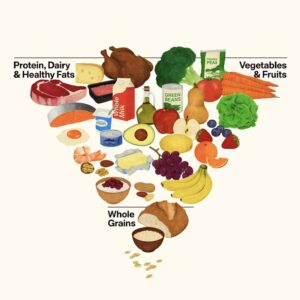
So, what’s actually changed?
Public reaction suggests that nutrition guidance has been fundamentally ‘flipped,’ particularly around carbohydrates, fats and animal foods.
However, upon review of the new guideline document, it is much less exciting. Many of the core principles remain unchanged, with intake of vegetables, fruits, whole grains, legumes, nuts and seeds still central.
Comparing recommended food group serves for a standard 2,000 calorie per day diet across the US and Australian guidelines (see Table 1), shows only modest shifts. There is slightly less emphasis on carbohydrates and slightly greater acknowledgement of fats, but the overall pattern is strikingly similar.
Table 1: Daily serve comparison (2,000 calorie energy budget per day)
| Food Group | U.S. Guidelines (2025–2030) | Australian Guidelines (2013) |
| Whole grains/cereals | 2-4 serves | 6 serves |
| Fruit | 2 serves | 2 serves |
| Vegetables | 3 serves* | 5-6 serves |
| Protein foods | 3-4 serves | 2.5–3 serves |
| Dairy | 3 serves | 2.5 serves |
| Healthy fats | 4.5 serves | 2–4 serves** |
* Serves of vegetables in the US are based on salad vegetable volumes, therefore the above guidelines equate to similar targets to Australia.
** Dietary fats ranges referenced from the full Australian Dietary Guidelines document (NHMRC, 2013, pg 72).
Points of agreement
There are some aspects of the new guidelines that many dietitians agree with.
- A continued emphasis on whole and minimally processed foods, reflecting the strongly emerging link between ultra-processed foods and poorer health outcomes.
- Clearer and more specific messaging around limiting added sugars, moving beyond abstract targets and towards per-serve guidance in some food categories.
- An ongoing recognition that healthy fats and adequate protein matter, and that blanket low-fat messaging has caused harm in the past.
- Elements that have opened useful conversations about emerging evidence on the fat/cholesterol link with heart disease risk, protein requirements and assumptions around minimum carbohydrate needs.
- Public-facing materials that appear more accessible, which may improve engagement for some audiences.
What requires a closer review
There are substantive concerns in the new guidelines that warrant attention:
- The guidelines encourage limiting ‘highly processed foods’ but provide little practical clarity. Without clear definitions, people struggle to distinguish between moderately processed but nutritious foods (such as yoghurt, frozen vegetables and fortified staples) and ultra-processed products high in added sugars, refined starches and sodium.
- The recommendation to keep saturated fat below around 10% of total energy, which leaves limited room for foods containing saturated fat, unless most added fats come from unsaturated sources. Based on the same 2,000 calorie/day diet, this equates to a target of <22 g saturated fat per day. As shown in Table 2, common dairy and protein foods alone use most of this allowance before any added fats are included.
Table 2. Daily saturated fat from dairy and protein foods only (no added fats)
| Food | Portion | Saturated fat (g) |
| Eggs | 2 large eggs | 2.3 |
| Full-cream milk | 250 mL | 5.6 |
| Natural yoghurt (3.5% fat) | 150 g | 2.7 |
| Cheddar cheese | 20 g | 4.3 |
| Lean cooked beef (trimmed) | 100 g | 1.5 |
| Total | 16.4 g |
- There are inconsistencies in the final document. The ongoing reliance on outdated DRI (Dietary Reference Intakes) references across parts of the website is contradictory of the new guidelines wording, likely leading to confusion for both consumers and health professionals.
- Overemphasise of animal foods: While plant-based foods are not discouraged, animal-source foods are prioritised in both the text and imagery of the new guidelines. This framing raises considerations regarding nutritional balance and the suitability of a more animal-focused dietary pattern for individuals facing financial or cultural constraints. The guidelines also give limited attention to the ethical and environmental implications associated with greater reliance on animal products.
- The guidelines explicitly state that their recommendations are intended to be based on scientific evidence alone, rather than being shaped by considerations such as equity, affordability or access. While this approach is intended to define an ideal dietary pattern, it does not consider whether people can follow the advice in practice. This is particularly relevant given that one in nine US households experience food insecurity, with similar rates reported in Australia, where more than 13% of people face food insecurity, with higher rates in disadvantaged communities (ABS, 2023). As a result, recommendations that emphasise fresh, diverse food may have limited applicability at a population level, raising questions about how well the guidance fulfils its role of a national dietary guideline.
- Guidelines such as these, which rely so heavily on fresh, diverse foods, will struggle to translate into impact unless affordability and access are meaningfully addressed. While this document is user friendly for the general public, it lacks the nuance that a health equity lens would bring when it comes to putting it into practice.
- There are legitimate questions around transparency and scientific consistency. Previously, recommendations more clearly aligned with the independent scientific advisory committee. It appears that some recommendations do not reflect the strongest available evidence, which raises concerns about political and industry influence.
“So, what should people actually eat?”
Despite the noise, there is still broad agreement on foundational principles of nutrition. Emphasising whole or minimally processed foods, prioritising a wide variety of vegetables, fruits, legumes and fibre-rich foods, including adequate protein from a range of sources, choosing mostly unsaturated fats, and limiting ultra-processed foods and sugary beverages remain widely supported.
Equally important is grounding dietary patterns in cultural relevance and personal sustainability. There are multiple pathways to achieving these principles. No single dietary viewpoint works for everyone.
Why dietary guidelines alone aren’t enough
Dietary guidelines are population-level tools. They are blunt by design. Problems arise when we expect them to function as personalised prescriptions.
Even if perfectly designed, guidelines have limited influence on their own. Food choices are shaped far more by cost, convenience, availability, marketing, culture and habit than by government documents. If someone cannot afford food, they will eat whatever they can obtain.
Meeting people where they are at and helping them make healthier choices, within their personal circumstances, will always be better than applying a blanket approach.
References
Dietary Guidelines for Americans, 2025–2030 U.S. Department of Health and Human Services & U.S. Department of Agriculture (2026.)
Food insecurity Australian Bureau of Statistics (2023.)
Australian dietary guidelines: Providing the scientific evidence for healthier Australian diets National Health and Medical Research Council (2013.)
Food security in the U.S – key statistics and graphics United States Economic Research Service (2023.)
Have you heard of our Diabetes in Depth training?
Diabetes In Depth is designed for GPs, nurses (enrolled and registered), dietitians, diabetes educators, pharmacists, exercise physiologists, and other allied health professionals involved in diabetes care.
This comprehensive training provides essential knowledge and practical skills to help you better support people living with diabetes. Through interactive learning and the opportunity to ask questions, you’ll gain insights that can be immediately applied — whether you work in a hospital, general practice, community health or an aged care setting.